

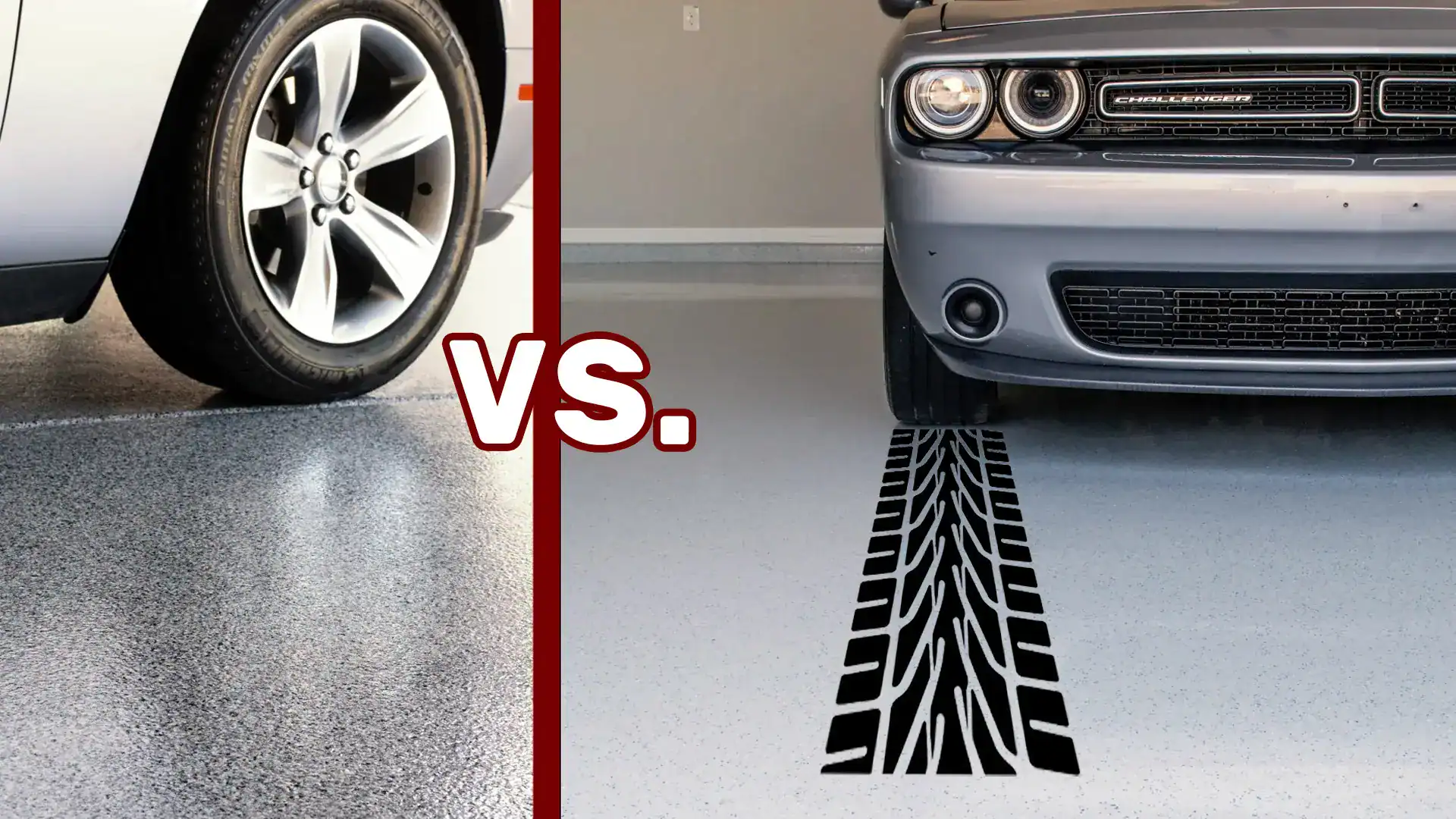
Hot tire transfer is among the most common and misunderstood reasons garage floor coatings fail. Many homeowners assume that if a coating looks good on installation day, it will hold up under daily use. The reality is more nuanced. Not all polyaspartic floor coatings are designed to handle the stress your tires put on them.
Myth: Hot Tire Transfer Only Happens in Extreme Heat
It’s easy to think this problem only shows up in hot climates or during peak summer months. In reality, it can happen more often than expected.
Try this. Feel your tires before you drive. Then check them again after your trip. Even normal driving creates enough friction to noticeably warm the rubber.
Car tires contain plasticizers that keep them flexible. As tires heat up, these softening agents migrate to the surface. Once parked, those plasticizers can transfer into the garage floor coating below, leaving behind tread marks, discoloration, or even beginning to peel a coating that cannot handle it.
Myth: All Polyaspartic Floor Coatings Prevent Hot Tire Transfer
The term “polyaspartic” is often used broadly, but not all coatings are created equal.
Many “1-day” coating systems use lower-quality polyurea or polyaspartics that are not densely cross-linked and are less than 100%-solids. In a “1-day” system, these quick-cure products are applied: (a) as the direct-to concrete primer coat (bad idea), and (b) as a single, thin clear top coat. As base coats, these less-than-100%-solids, quick-cure coatings are susceptible to future moisture-related issues, and as topcoats, susceptible to hot tire transfer (and other problems).
Because of this, many “1-day” companies exclude “moisture-related issues” and hot tire transfer from their warranties (or recommend using vehicle pads!!!). That raises an important question. What is the coating actually designed to withstand?
Reality: System Design Determines Whether a Polyaspartic Floor Coating Holds Up
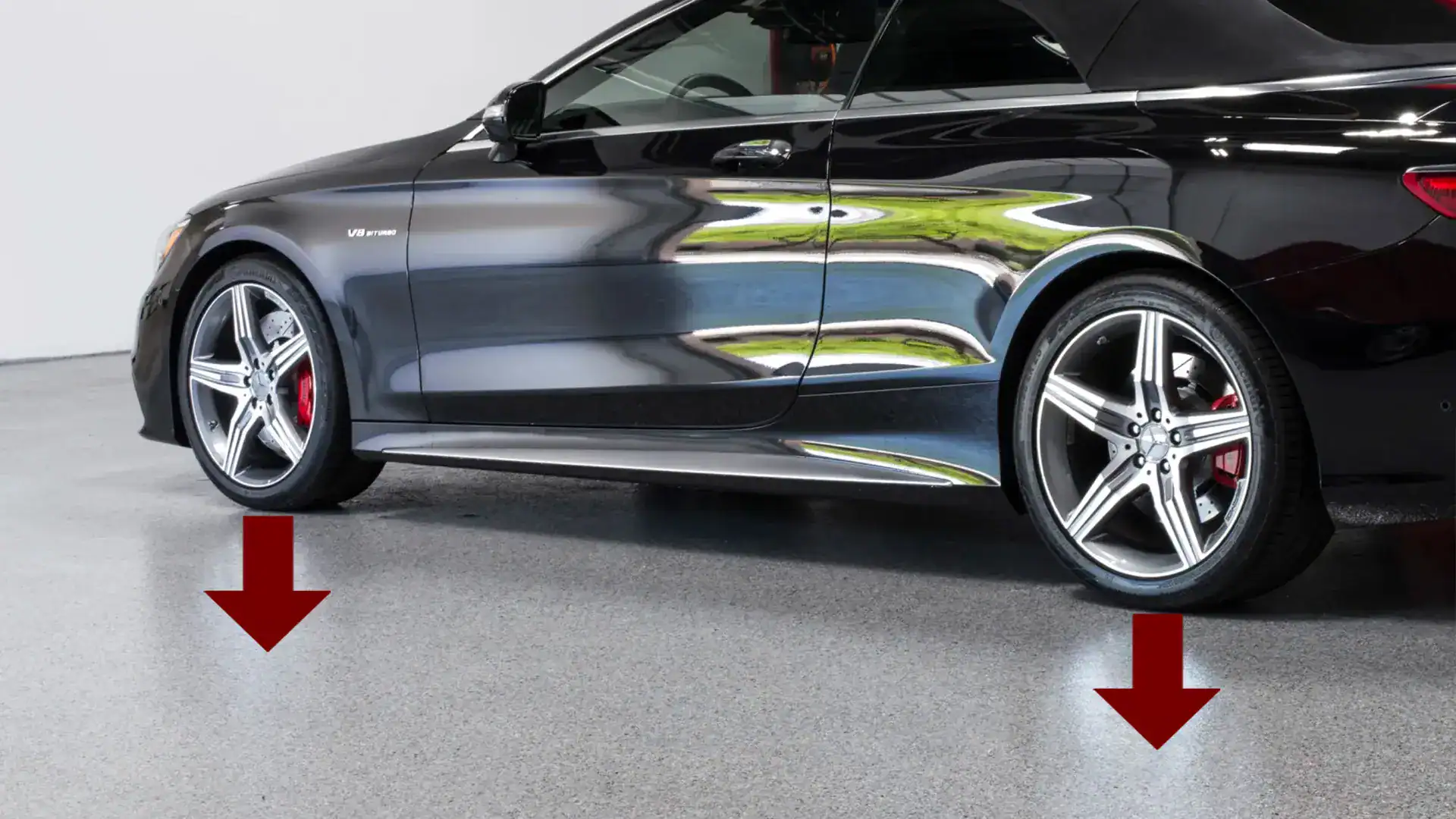
At GarageFloorCoating.com, we install a quality 2-day system, taking the time to apply quality 100%-solids coatings, using the proper coating type in each layer, to derive long-term performance. As a result, our coating systems simultaneously mitigate for moisture-related issues and hot-tire transfer.
Day one begins with mechanical grinding to open the concrete surface and ensure strong adhesion of the first coat. A high-build, slower-curing, moisture-mitigating, 100%-solids epoxy base coat is applied and allowed to cure slowly. This step is critical. It allows the epoxy to slowly and deeply penetrate the concrete slab, forming a strong bond. It acts as a moisture vapor barrier, protecting against future moisture vapor transmission…one of the leading causes of coating failure.
A full flake broadcast is embedded into this base epoxy layer, adding both texture and thickness to the system.
On Day two, we apply two (not one) layers of our highly cross-linked, 100%-solids polyaspartic. These dual clear topcoats create a dense, protective surface that resists heat, pressure, wear…and hot-tire transfer!
Reality: Polyaspartic Floor Coatings Provide More Than Just Hot Tire Protection
When installed as part of a complete system, quality polyaspartic coatings offer multiple insane protection.
They provide UV stability to prevent yellowing or fading, even in sun-exposed garages…and resist chemicals like oil, gasoline, and household cleaners. They also create a non-porous surface that is easy to clean and maintain.
Most importantly, they form a barrier that prevents hot tire pickup, helping your floor maintain its appearance over time.
Reality: The Right System Solves the Problem Before It Starts
Hot tire transfer is not unavoidable. It’s simply the result of using a system that isn’t built to handle real-world conditions.
A properly installed polyaspartic coating, built on a moisture-mitigating epoxy base, is designed to stop that damage before it begins.
Contact GarageFloorCoating.com today to learn more about polyaspartic floor coatings designed to prevent hot tire transfer and deliver long-term performance.
About the Author

Share this Post